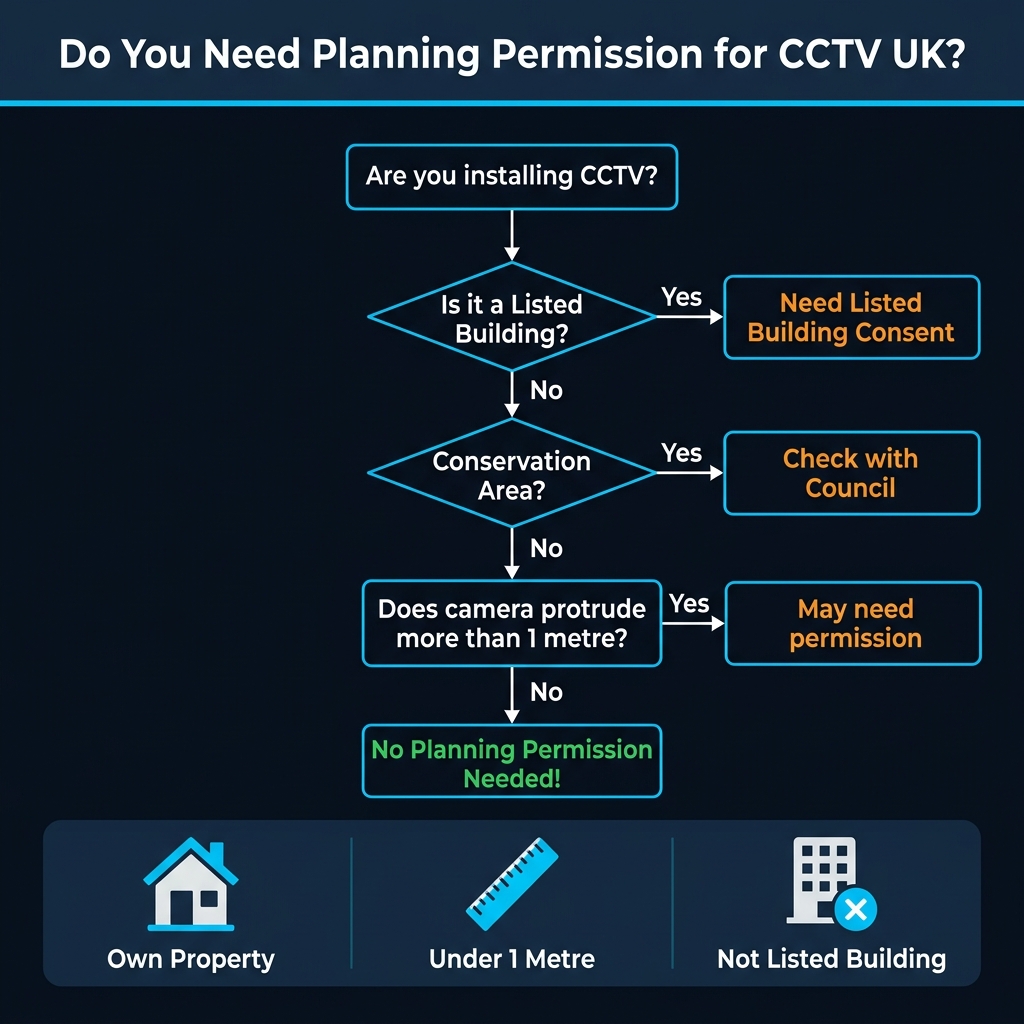
For the vast majority of UK homeowners, the answer is no — you do not need planning permission for CCTV. Domestic CCTV installations are classified as "permitted development" under the Town and Country Planning Order, meaning you can install cameras without applying to your local council. However, legal boundary conditions apply.
⚖️ UK Compliance & Regulations Cheat Sheet
Permitted Development Rights Explained
Permitted development rights allow most UK homeowners to install security cameras without submitting a formal planning application, provided the installation adheres to strict size and placement criteria. Permitted development rights are a set of automatic planning approvals granted by the government for common types of home improvement. They mean you don't need to submit a full planning application for everyday changes like building a small extension, putting up a fence, or installing security cameras.
The legal basis for domestic CCTV as permitted development comes from the Planning Portal (GOV.UK), which confirms that CCTV installations on homes are generally permitted as long as they meet certain criteria.
The 5 Rules to Stay Within Permitted Development
To ensure your security camera system qualifies under permitted development, you must strictly follow five core rules regarding camera size, positioning, distance from boundaries, and total system limits. Rule 1: Purpose. The camera must be installed for security and property protection purposes only.
Rule 2: Protrusion. The camera must not protrude more than 1 metre from the wall or roof slope it's mounted on. If you mount a dome or bullet camera on a bracket, keep the total distance under 1 metre.
Rule 3: Location. The building must not be a listed building, and must not be within the curtilage of a listed building.
Rule 4: Designated areas. If you're in a National Park, the Broads, an Area of Outstanding Natural Beauty (AONB), or a World Heritage Site, additional restrictions apply.
Rule 5: No highways obstruction. The installation must not obstruct public highways, rights of way, or cause a hazard.
Listed Buildings & Conservation Areas
If you live in a listed building or a designated conservation area, standard permitted development rights are heavily restricted, meaning you will almost certainly need to apply for planning permission or listed building consent before installing CCTV. If your home is a listed building, the rules are considerably stricter. You'll need Listed Building Consent before making any alterations to the exterior — including CCTV installation. Carrying out unauthorised works to a listed building is a criminal offence, and ignorance is not a defence.
For conservation areas, it depends on whether the camera would be visible from a public highway. Front elevation cameras typically need prior approval.
Complying with BS 8418 for Professional CCTV Installations
Adhering to the BS 8418 standard is essential for professional, police-monitored CCTV installations in the UK, ensuring that your system is reliable, secure, and legally recognized. For a professional and secure installation, it's recommended to adhere to the British Standard BS 8418. This standard provides guidelines on the design, installation, and monitoring of closed circuit television (CCTV) for security purposes. Following these standards ensures that your CCTV system is effective in deterring crime while respecting privacy rights.
Compliance with BS 8418 involves factors such as camera positioning to avoid capturing private areas unnecessarily, ensuring data protection through encryption and secure storage of footage, and maintaining clear signage indicating the presence of surveillance cameras. This not only helps in avoiding legal disputes but also enhances public trust in your security measures.
Wiring Your CCTV System: Adhering to BS 7671
Any hardwired security system must be installed in full compliance with BS 7671 wiring regulations to guarantee electrical safety and protect your property from potential fire hazards. When installing your CCTV system, it's crucial to adhere to the wiring standards set by BS 7671 (Requirements for Electrical Installations). This ensures that your electrical work is safe and compliant with UK standards. For instance, all cables must be properly insulated and protected against physical damage, moisture, and other environmental factors.
Additionally, ensure that your CCTV system's power supply meets the necessary voltage and current ratings as per BS 7671. This includes using appropriate circuit breakers or fuses to protect against overcurrent. Properly labeling and documenting your electrical work is also essential for future maintenance and compliance checks.
Considering the Cost of CCTV Installation in the UK
When planning your security budget, it is vital to balance the upfront equipment and installation expenses against long-term reliability and compliance costs. The cost of installing a CCTV system can vary widely depending on factors such as the number and type of cameras, recording equipment, storage solutions, and professional installation fees. On average, you might expect to spend between £500 to £2000 for a basic to advanced setup. Prices can go higher for more complex systems with features like facial recognition or thermal imaging.
When budgeting for your CCTV system, it's also important to factor in ongoing costs such as maintenance, storage upgrades, and potential legal fees if you encounter any issues related to planning permission or privacy infringement. Investing in a reliable and scalable system from the start can save you money in the long run.
Video Walkthrough
Planning Permission Rules by Property Type
| Property Type | Planning Required? | Key Restriction |
|---|---|---|
| Standard Detached/Semi/Terraced House | No (Permitted Development) | Max 1m protrusion, not listed |
| Flat or Maisonette | Often Yes | Requires leasehold/freeholder consent |
| Listed Building | Yes (Always) | Requires Listed Building Consent |
| Conservation Area | Sometimes | If visible from public highway |
Frequently Asked Questions
Need a Professional Quote?
Our certified UK engineers are ready to help. Get a free, no-obligation quote for professional installation tailored to your property.