Yes — home CCTV is entirely legal in the UK. However, whether you have legal obligations under the Data Protection Act 2018 (UK GDPR) depends entirely on what your cameras capture. If they record beyond your property line, you must comply with data protection regulations.
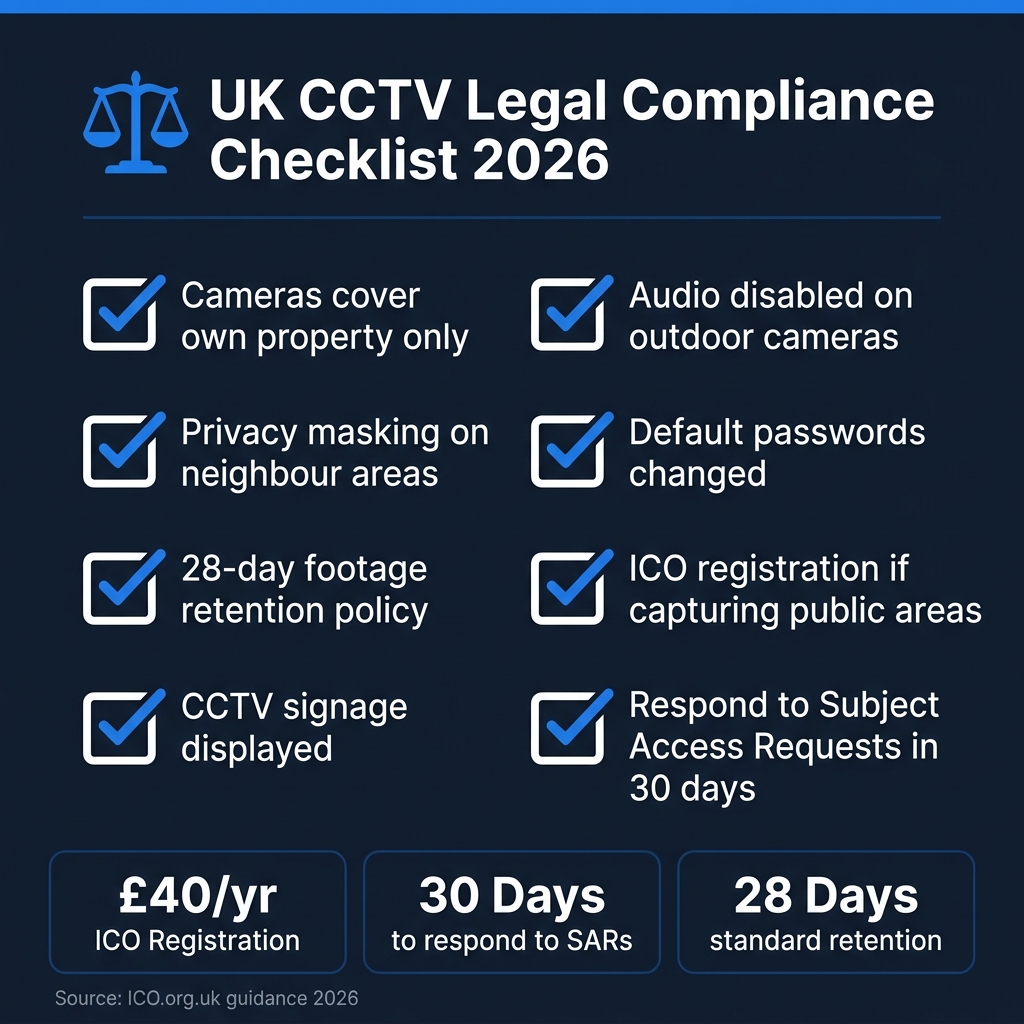
⚖️ UK Compliance & Regulations Cheat Sheet
The Domestic Purposes Exemption
Under UK law, the domestic purposes exemption completely exempts you from data protection regulations as long as your security cameras capture footage strictly within the boundary of your own private property. If your security cameras only capture images within the boundary of your private domestic property, you are completely exempt from UK GDPR rules.
However, if your cameras capture a neighbour's garden, driveway, or the public pavement, you are classified as a "data controller" and must follow ICO guidelines.
Understanding the ICO Registration Process
If your domestic CCTV cameras capture images beyond your property boundary, you are legally classed as a data controller and must register with the Information Commissioner's Office (ICO) and pay an annual data protection fee. If your CCTV system captures images beyond your property boundary, you must register with the Information Commissioner's Office (ICO). This registration is a legal requirement under the Data Protection Act 2018. The process involves providing detailed information about your data processing activities to the ICO, including the types of data collected, how it will be used, and the security measures in place to protect that data.
To register with the ICO, you must complete an online application form, which includes questions about your CCTV system's capabilities, storage duration, and data retention policies. You may also need to provide evidence of your compliance with UK GDPR requirements, such as privacy notices or data protection impact assessments (DPIAs).
Complying with Neighbour Rights and Privacy
To respect your neighbours' privacy rights and avoid legal disputes, you must ensure your cameras are positioned to avoid capturing their private spaces and be prepared to respond to Subject Access Requests for any footage you hold of them. When installing CCTV on your property, it is essential to consider the privacy rights of your neighbours. The law states that you cannot install cameras in a way that would allow you to capture images or audio from private spaces, such as gardens or indoor areas, without consent. This means that if your camera's field of view extends beyond your property boundary and captures any part of your neighbour's property, you must obtain their written consent.
In addition to obtaining consent, you should also ensure that your CCTV system is securely installed and protected from tampering or unauthorized access. This may involve installing the cameras on a sturdy, fixed structure, such as a brick wall or metal pole, and using appropriate security measures to prevent tampering.
Data Retention and Disposal Policies
Operating a legal home CCTV system means you should only store recorded footage for as long as strictly necessary—typically 31 days—before securely and permanently deleting it. Under UK GDPR, you are required to have a clear data retention policy in place for any personal data collected by your CCTV system. This means that you must specify how long the data will be stored, and what measures will be taken to protect it during storage and disposal.
Your data retention policy should take into account factors such as the type of data captured (e.g., images or audio), the purpose for which it is being collected, and any legal obligations that may require you to retain certain data for a specific period. You should also have procedures in place for securely disposing of data when it is no longer needed.
Video Walkthrough
Legal Requirements based on Camera View
| Camera View | ICO Rules Apply? | Action Required |
|---|---|---|
| Strictly private garden/drive | No | None (exempt) |
| Captures neighbor window/garden | Yes | Apply privacy masking or adjust angle |
| Captures public street/footpath | Yes | Put up signs, set auto-overwrite, disable audio |
Frequently Asked Questions
Need a Professional Quote?
Our certified UK engineers are ready to help. Get a free, no-obligation quote for professional installation tailored to your property.